


As Hair Loss Awareness Month approaches this August, it’s worth asking a more useful question than “is my hair thinning?” If you’ve noticed a widening part, a thinner ponytail, or more hair left behind after washing or brushing, you likely already know something has changed. The more useful question is how to fix thinning hair, and which treatments actually have evidence behind them. At AURĀE Modern Medical + Spa, we start every hair loss treatment conversation in Charleston and Mount Pleasant the way we approach the rest of your care: by looking at the whole picture, not just the hair.
What’s Actually Causing Your Thinning Hair?
Not all hair loss is the same, and that matters more than most people realize when they’re weighing hair loss treatment options. A widening part caused by female pattern hair loss is a different condition from temporary shedding after a stressful year, an illness, or childbirth. Both are different still from traction alopecia, scalp inflammation, or hair loss tied to a nutritional deficiency.
When an unusually large number of hairs shift into the shedding phase at once, it’s called telogen effluvium, and it can follow a fever, surgery, childbirth, rapid weight loss, major dietary changes, or a period of significant stress. The shedding often doesn’t show up right away. It tends to appear two to three months after the trigger, and in most cases, hair growth returns once the underlying trigger resolves or is treated.
Female pattern hair loss follows a different course. It’s usually progressive, and it tends to show up first as a widening part, a less full ponytail, or gradual thinning across the top of the scalp rather than sudden, all-over shedding. The distinction matters because the right next step, whether that’s watching and waiting, addressing a trigger, or starting active treatment, depends entirely on which one you’re dealing with.
Female Pattern Hair Loss: The Most Common Cause
Female pattern hair loss, also called female androgenetic alopecia, is the most common form of hair loss in women. It often becomes noticeable in midlife, though it can begin earlier, and treatment tends to work better when it’s started at the first signs of thinning rather than after significant follicle miniaturization has already occurred.
Does Menopause Play a Role?
Female pattern hair loss is more common after menopause, and hormonal shifts may contribute. Postpartum estrogen changes can also trigger temporary shedding. That said, hair changes around menopause are worth discussing as part of a broader conversation about your health rather than assuming that balancing hormones alone will reverse the thinning. If hormonal symptoms are part of the picture, we can talk through whether a broader wellness consultation makes sense alongside hair-specific treatment.
Could Stress Be the Cause?
Major physical or emotional stress can disrupt the hair cycle and trigger temporary shedding, but that doesn’t mean every form of thinning hair traces back to stress or cortisol. Persistent, patterned thinning, especially along the part or crown, often has a different underlying cause and deserves its own evaluation rather than a one-size-fits-all explanation.
Why a Consultation Comes Before Any Treatment
Because thinning hair can stem from so many different causes, effective treatment starts with figuring out which one you’re actually dealing with. During a hair restoration consultation, we review the pattern and timeline of your hair changes, your medical history, medications, stress levels, weight changes, and any pregnancy or menopause-related shifts, along with a scalp examination. Depending on what we find, we may recommend blood work or further evaluation when a deficiency, hormonal imbalance, or inflammatory condition is suspected. Not everyone needs the same testing. It depends on your history and what your scalp is telling us.
The Best Treatments for Thinning Hair, Backed by Evidence
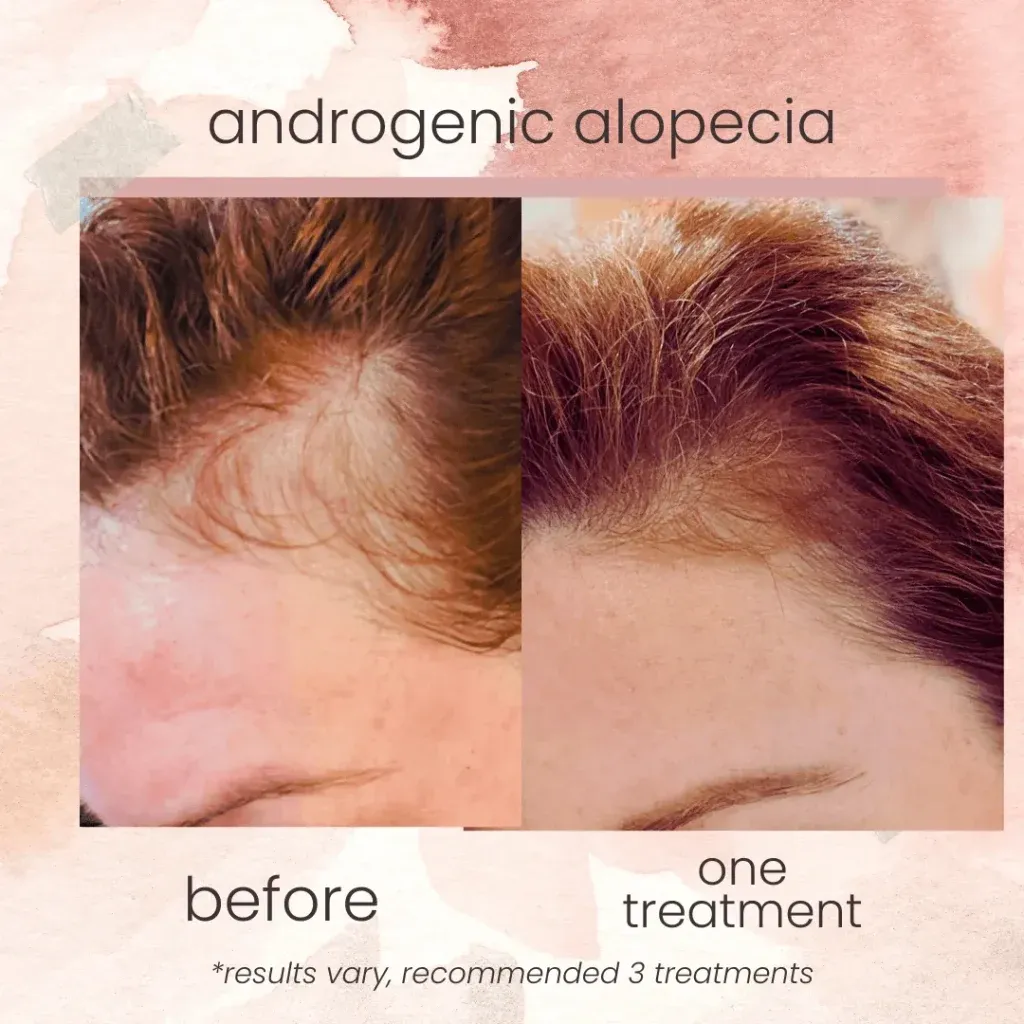
There isn’t one universal hair loss treatment that works best for everyone. The honest answer is that it depends on your diagnosis, and different treatments carry different levels of evidence. Here’s how we think about each option.
Topical Minoxidil: The Established First Step
Topical minoxidil is the only treatment FDA-approved specifically for female pattern hair loss, and it remains the most commonly recommended first-line option. It generally takes six to twelve months of consistent, daily use to judge how well it’s working, some people notice increased shedding in the first few weeks before things improve, and benefits tend to fade once treatment stops. Pregnancy and breastfeeding affect candidacy, so this is always a conversation we have directly rather than a one-size-fits-all recommendation.
PRP: Promising Evidence, With Some Real Caveats
Platelet-rich plasma (PRP) uses a small sample of your own blood, processed to concentrate the platelets before it’s applied to the scalp. Recent systematic reviews and meta-analyses have found that PRP may meaningfully improve hair density and thickness in women, including those with androgenetic alopecia, with a favorable safety profile overall. At the same time, protocols vary widely between providers, and researchers have flagged inconsistency in study design as a reason to view results as promising rather than definitive. At AURĀE, PRP for scalp restoration typically involves a blood draw, centrifugation to isolate the platelet-rich plasma, application to the scalp, and a treatment series followed by maintenance sessions.
Prescription Medications: Not a Fit for Everyone, But Worth Knowing About
Topical minoxidil is the only FDA-approved treatment for female pattern hair loss, but depending on your diagnosis and history, a qualified prescriber may also discuss oral medications such as spironolactone or other anti-androgen therapies, particularly when hormonal factors appear to be involved. These medications carry real contraindications, monitoring requirements, and pregnancy risks, so they’re a decision made individually with your provider rather than a default recommendation. We’re mentioning them here for completeness, not as a medication guide. If they seem relevant to your situation, that’s a conversation for your consultation.
Low-Level Laser Therapy: A Non-Invasive, Ongoing Option
We offer low-level laser therapy in-office as part of a broader hair restoration plan. Also called photobiomodulation, it’s thought to stimulate hair follicle activity through improved microcirculation and cellular signaling. Real-world and clinical studies report meaningful improvement for many patients with androgenetic alopecia, though effectiveness varies by device, diagnosis, and how consistently it’s used. It’s best understood as an ongoing commitment rather than a one-time fix, and evidence is weaker for shedding caused by telogen effluvium than for pattern hair loss.
Microneedling: A Strong Support Treatment, Not a Standalone Cure
Our scalp microneedling treatments create controlled micro-channels that can improve the absorption of topical treatments and support overall scalp health. Research combining microneedling with minoxidil has shown better outcomes than minoxidil alone in some studies of androgenetic alopecia. On its own, though, microneedling isn’t a substitute for addressing a hormonal, nutritional, autoimmune, or scarring cause of hair loss.
Hair Growth Serums: Support Between Visits
For some patients, we also recommend specialized hair growth serums or topical treatments for home use between in-office visits. These are chosen based on your diagnosis rather than handed out as a one-size-fits-all add-on, and they work best as part of a broader plan rather than on their own.
Emerging Regenerative Options
Regenerative treatments that use a patient’s own hair follicle cells to create a personalized, cell-derived product are an emerging area of interest in hair restoration. These approaches are designed to support the follicle environment and may be considered as part of a broader, personalized plan for the right candidate. Through our partnership with Acorn Labs, Aurāe offers regenerative hair restoration that uses your own hair follicle stem cells to create a personalized treatment designed specifically for you.
When Hair Transplantation Still Has a Role
For patients with stable pattern hair loss and enough donor hair, surgical hair transplantation redistributes existing follicles rather than correcting every underlying cause of hair loss. Non-surgical and regenerative options don’t replace transplantation for the right candidate. If a surgical consult seems like the more appropriate path based on what we find, we’ll tell you that directly.
What About Supplements and Biotin?
Deficiencies in nutrients like iron, or inadequate protein intake, can contribute to hair thinning, but supplementing without confirming an actual deficiency generally doesn’t help, and excess intake of some nutrients, including vitamin A and selenium, has been linked to hair loss rather than prevention of it. Biotin in particular has little supporting evidence in people without a diagnosed deficiency, despite its popularity. Volumizing shampoos can make hair look and feel fuller in the moment, but they don’t regrow hair or stop progressive shedding. If nutrition is playing a role in your hair changes, we’d rather confirm that with a look at your history and, if appropriate, some lab work, than have you guessing at a supplement aisle.
Best Hair Loss Treatment for Women: Building a Personalized Plan
Because thinning hair rarely has a single cause, the most effective female hair loss treatment plans usually combine approaches rather than relying on one alone. A plan might pair topical minoxidil with in-office PRP, add low-level laser therapy for ongoing support, regenerative treatments, or use microneedling to help a topical treatment absorb more effectively. What we won’t do is hand you the same protocol we’d hand anyone else. Your plan should reflect your diagnosis, your timeline, and what you’re realistically able to stick with, since consistency matters more to the outcome than any single treatment on its own.
Hair Restoration Is Rarely a One-Time Treatment
Whatever combination of treatments makes sense for you, ongoing maintenance is usually part of the plan rather than an afterthought. Depending on your diagnosis and how you respond, that might mean continuing topical minoxidil, repeating PRP sessions on a set schedule, keeping up with low-level laser therapy, or returning for a follow-up regenerative treatment. We also track progress with photos over time and reassess if your shedding pattern changes, since a plan that’s working shouldn’t be left on autopilot, and one that isn’t should be adjusted rather than continued out of habit.
Frequently Asked Questions
What is the best hair loss treatment for women?
There isn’t a single best treatment for every woman. Topical minoxidil has the strongest evidence base and is usually the first step, but PRP, low-level laser therapy, regenerative treatments and microneedling are often layered in based on your diagnosis and goals. The best treatment for thinning hair for women is the one built around what’s actually causing it.
How long does it take to see results?
Most treatments for thinning hair, including minoxidil and PRP, take several months of consistent use before results are noticeable, and six to twelve months to fully judge effectiveness. Hair restoration is a gradual process, not an overnight fix.
Is PRP or minoxidil better for thinning hair?
They’re not competing options so much as complementary ones. Minoxidil has the longer track record and FDA approval for female pattern hair loss, while PRP shows promising results as an in-office treatment, especially when paired with a topical routine. Many patients use both.
Can stress really cause noticeable hair loss?
Yes. Significant physical or emotional stress can trigger telogen effluvium, a temporary shedding phase that typically resolves within several months once the trigger has passed. Ongoing or patterned thinning that doesn’t improve is worth having evaluated separately.
Do I need blood work before starting treatment?
Not always. Testing is recommended based on your symptoms, history, and scalp examination rather than as a standard step for everyone. We’ll let you know if it’s appropriate for your situation during your consultation.
Ready to Find Out What’s Actually Going On?
Thinning hair is treatable more often than people expect, but the right approach depends on understanding the cause first. If you’re noticing changes and want a clear, medically grounded answer rather than another guess, we’d love to help you schedule a hair restoration consultation at our med spa serving Charleston and Mount Pleasant.